
Shattering a lock with “air.”
The book is out! To celebrate, let’s learn how to turn a solid steel padlock into glass using basic chemistry.

THE COUNTERMEASURE
The Eagle has Landed.
As of Monday, Stone Cold Webb is officially out in the wild.
I want to say a massive thank you to everyone who has already ordered a copy. Seeing the photos of the book arriving on your doorsteps has been surreal. Writing is a lonely job; realizing actual humans are reading the words is the payoff.
If you haven’t grabbed it yet, the link is at the bottom. But the celebration is over. Niko Webb never stops working.
While you are reading about Niko breaking into high-security bunkers, I want to show you one of the “dirtiest” tricks in his playbook. He doesn’t pick the lock. He freezes it.
The Tradecraft: Thermal Shock
The Myth vs. The Reality
You’ve seen it in movies: The spy sprays something on a lock, hits it with a hammer, and it shatters.
Is it real? Yes. But you don’t need liquid nitrogen from a science lab. You just need a can of “Dust-Off” (compressed air) from an office supply store.
The Science: Brittle Fracture
Steel is tough because it is ductile, it can absorb energy and bend slightly without breaking. But if you make steel cold enough, it loses that ductility. It becomes brittle. Like glass.
The Attack:
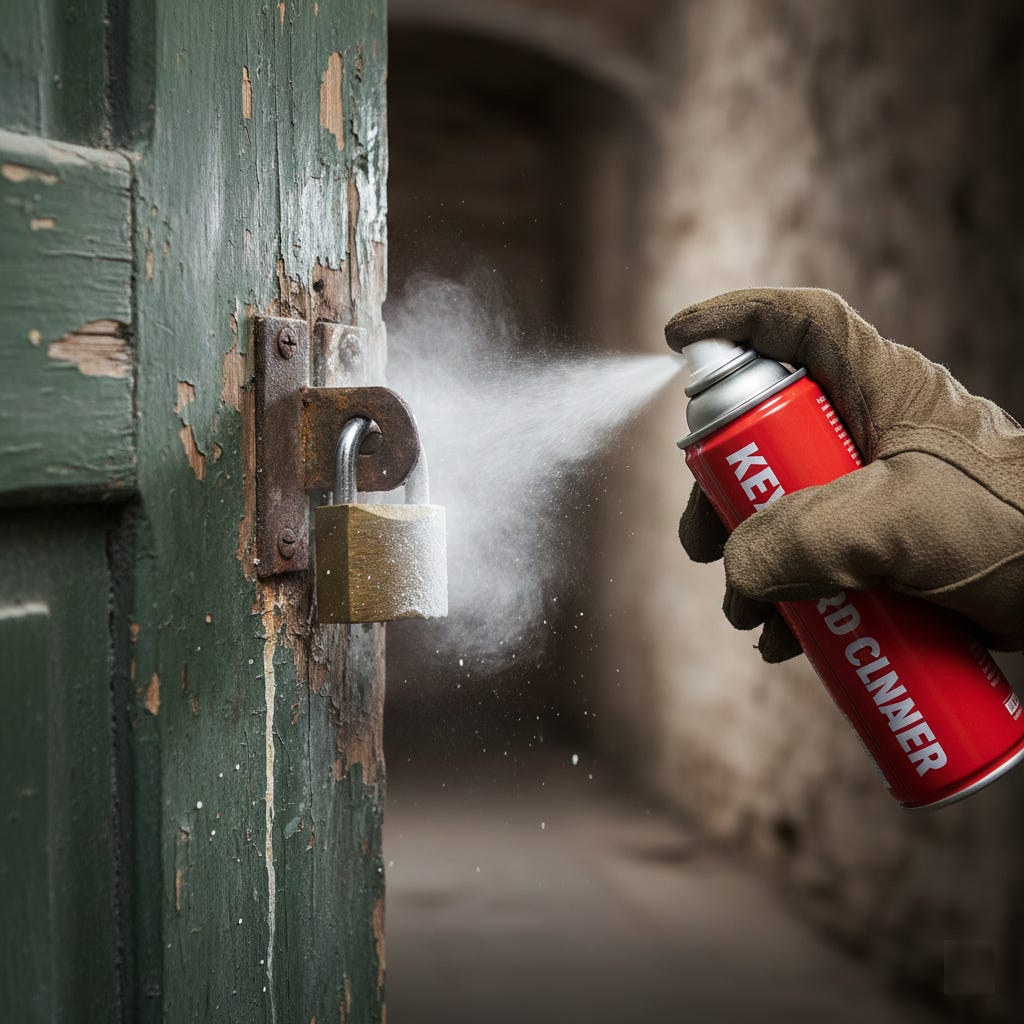
The Source: Niko takes a standard can of compressed air (difluoroethane).
The Inversion: He turns the can upside down. When you spray it upright, it shoots gas. When you spray it upside down, it shoots liquid propellant.
The Freeze: As that liquid hits the air and evaporates, it drops the temperature instantly to around -50°F (-45°C). He sprays it directly into the shackle of the padlock for about 20 seconds. frost forms. The metal groans.
The Strike: He takes a hammer (or a heavy rock) and strikes the shackle hard.
Crack.
Because the metal is frozen, it can’t absorb the shock. Instead of bending, it snaps.
Why It Works:
This works best on cheap-to-mid-range padlocks made of hardened steel. It exploits the material properties, not the locking mechanism. It’s loud, it’s messy, but it works when you don’t have lockpicks (or the patience) to be subtle.
The Countermeasure: Better Metallurgy
How do you stop this? You buy better locks.
High-security padlocks (like certain models from Abloy or Mul-T-Lock) use alloys specifically designed to resist cryogenic attacks. They might get cold, but they won’t shatter.
Also, many high-end locks use “shrouded” shackles, where the body of the lock covers most of the U-bar, making it hard to hit with a hammer even if you do freeze it.
Why This Matters
In Stone Cold Webb, I try to ground the action in real physics.
Hackers aren’t wizards. They are just people who understand how the world works better than the people who built it. If you understand thermodynamics, you can defeat a lock designed by a mechanical engineer.
The Sign-off
Thank you again for making launch week so special. If you’re enjoying the book, please leave a review, it helps the algorithm find more readers like us.
Next week, we are going digital. I’m going to show you why your home Wi-Fi password is likely cracked in under 60 seconds, and what a “Handshake Capture” looks like.
Stay dangerous,
Alex Holt